L4 autonomous driving is rapidly moving from experimentation to large-scale commercial adoption. Autonomous delivery vehicles navigate through communities, autonomous shuttle buses connect business parks — vehicles can be driverless, but supervision cannot be left unattended.
At the same time, the state has put forward clear requirements for vehicle supervision. In April this year, the Ministry of Industry and Information Technology, the Ministry of Public Security, and the Ministry of Transport jointly organized a working meeting on road testing and demonstration application of intelligent connected vehicles, emphasizing the need to strengthen whole-process safety supervision, improve emergency response capabilities, and ensure that testing and demonstration activities proceed safely and orderly.

Currently, intelligent connected vehicle supervision faces challenges at different stages: vehicle access processes need further digitalization and automation; vehicle operations require stronger and more dynamic real-time perception capabilities; accident handling needs complete data chains to support traceability and accountability.
As a result, supervision platform construction has shifted from "optional supporting facility" to "mandatory requirement."
With over a decade of deep experience in the connected vehicle sector, Sirun has launched the Intelligent Connected Vehicle Operation & Supervision Platform. Centered on two main pillars — vehicle network access approval and operational safety supervision — the platform establishes a full-process supervision system spanning pre-access, in-operation monitoring, and post-accident analysis, delivering closed-loop management from application and admission, to operational monitoring, safety alerting, and supervisory assessment.
Dual-5G On-board Intelligent Terminal: The Solid Foundation for Supervision Data
The first line of defense for safety supervision is the reliability of data collection and transmission.
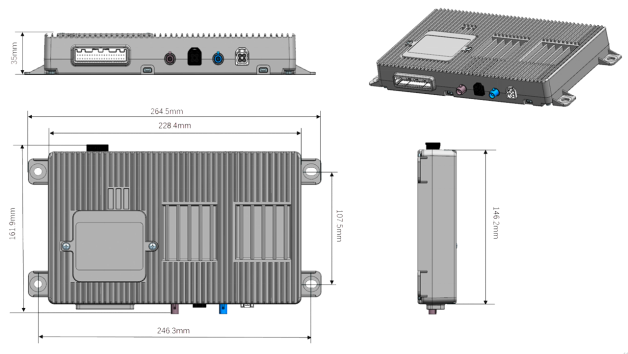
Sirun's automotive-grade intelligent on-board communication terminal, purpose-built for autonomous driving scenarios, is architected around the "Rockchip RK3568M main processor + dual-5G communication modules." It integrates two independent 5G modules and employs a dual-SIM, dual-standby, dual-active architecture to physically eliminate single-operator network coverage blind spots and signal instability.
Core performance specifications: Positioning accuracy of 1cm + 1ppm RMS, heading angle ≤0.5°, operating temperature range -40°C to 85°C, ingress protection rating IP52, and active-standby redundancy ensuring 99.99% online rate in complex scenarios.
Core functions:
Dual-5G Link Redundancy: Two SIM cards operate simultaneously with millisecond-level active-standby switching and bandwidth aggregation support, achieving zero communication interruption.
High-Precision Positioning: Dual-antenna RTK design breaks through the limitations of traditional single-point positioning, delivering centimeter-level positioning and stable heading angle in complex scenarios.
Domain Controller Network Interconnection: Built-in automotive-grade Ethernet switch that connects data channels across vehicle domain controllers.
National Cryptography Security: Built-in national cryptographic SM2/SM4 encryption chips to secure vehicle-to-cloud communication data.
The terminal has already achieved mass production, with leading autonomous delivery vehicle manufacturers having deployed Sirun's dual-5G on-board terminals for volume production deliveries.
Supervision Platform: Three-Layer Architecture, Full-Process Closed Loop
Sirun's Intelligent Connected Vehicle Operation & Supervision Platform is fully aligned with national standards, establishing a "Vehicle Terminal Layer — Enterprise Platform Layer — National Platform Interface Layer" three-tier data exchange system that enables full-process closed-loop management from data collection, transmission, and storage to compliance reporting.
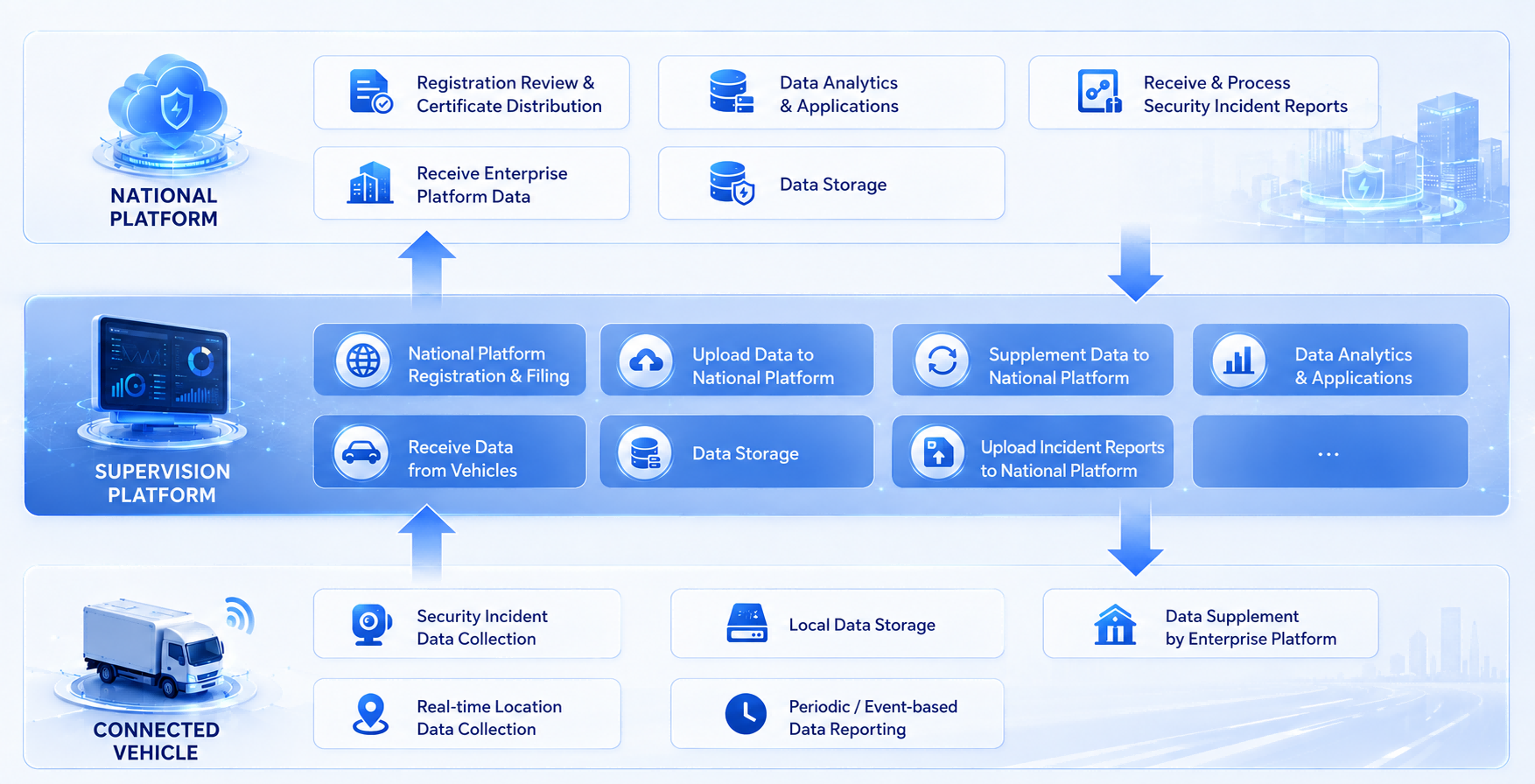
Vehicle Terminal Layer: Data Source Collection
Integrated T-BOX precisely captures vehicle dynamics, environmental perception, and driver status data in compliance with regulatory requirements. Automatic local caching during network disconnection ensures lossless data retransmission upon communication recovery; event-triggered uploads are completed within 10 minutes, strictly meeting national standard timing requirements.
Enterprise Platform Layer: Data Processing Hub
Automatically performs data cleansing, validation, and standardization conversion; packages and reports data according to national standard protocols with automatic retransmission support for anomalies; automatically generates immediate and annual compliance reports to meet regulatory review requirements.
National Platform Interface Layer: Secure Connectivity Channel
Establishes end-to-end encrypted links based on TLS 1.2+ protocols; fully compatible with national standard communication protocols and data formats; provides full-link real-time monitoring and anomaly alerts, ensuring 100% data delivery success.
From vehicle-side collection to cloud-side processing to national platform reporting — the entire chain complies with national standards, helping automakers pass regulatory reviews with ease.
Device-Cloud Synergy: Closing the Data Loop
Device-cloud synergy is the core driver of the three-layer architecture's efficient operation.
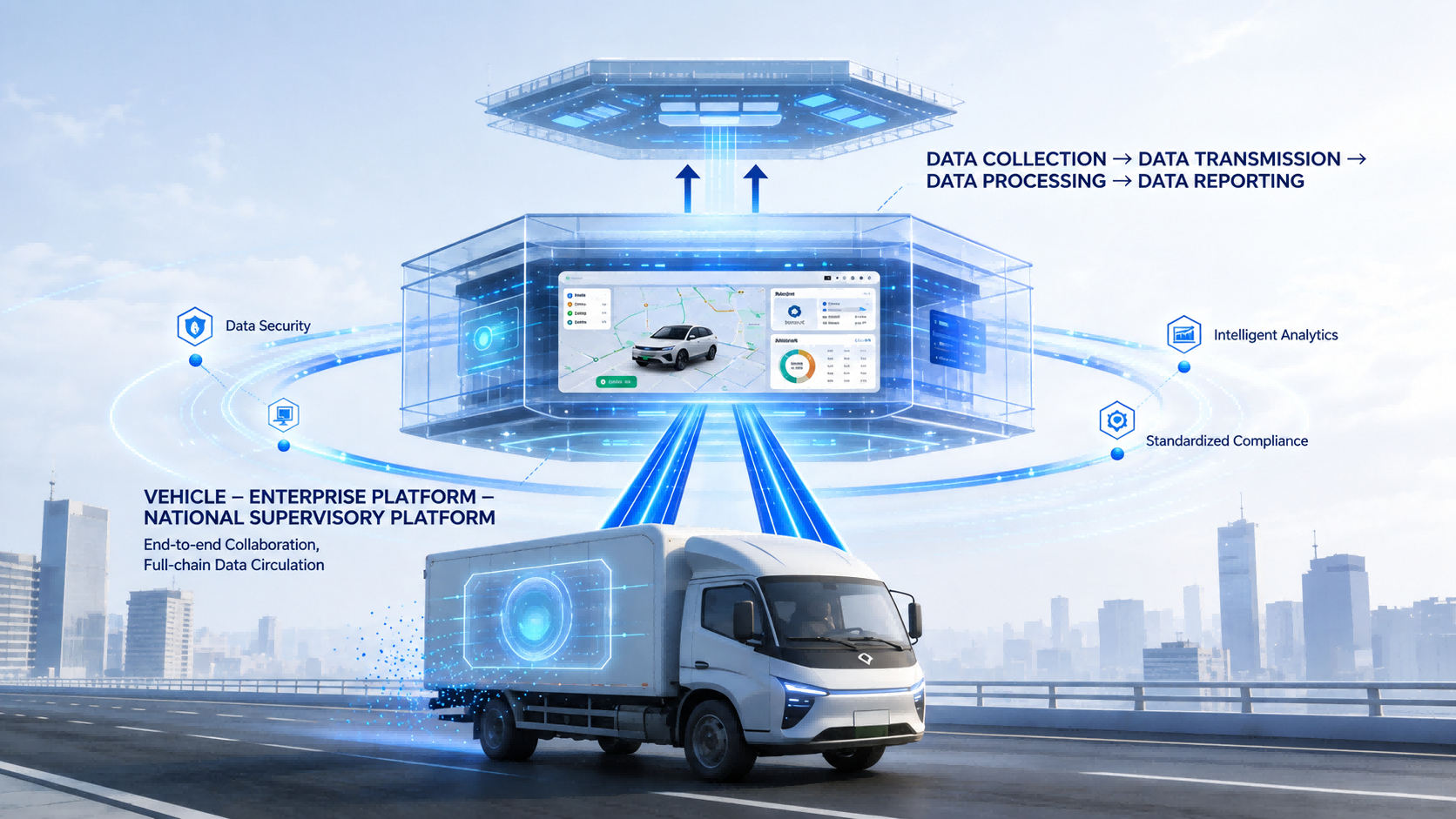
In Sirun's Intelligent Connected Vehicle Operation & Supervision Platform's three-layer system, the Vehicle Terminal Layer handles data collection, local caching, and encrypted upload; the Enterprise Platform Layer manages data parsing, standardized processing, and compliance reporting; and the National Platform Interface Layer oversees data reception, storage, assessment, and access decision-making. The three layers progress sequentially, forming a complete data loop from the vehicle to the cloud.
Sirun's dual-5G vehicle terminal provides critical underlying support for device-cloud synergy. Dual-5G link redundancy ensures uninterrupted real-time data backhaul; millisecond-level active-standby switching maintains continuous connectivity even in complex network environments; dual-antenna RTK high-precision positioning meets regulatory demands for trajectory accuracy; and built-in national cryptographic chips safeguard data security and compliance at the source. Only when the vehicle side can reliably collect, transmit, and localize data can cloud-side supervision operate on a solid foundation.
The key to this collaborative mechanism is: the vehicle side ensures data authenticity and real-timeliness, while the cloud side unlocks data value and application. When a vehicle experiences a safety event, the on-board terminal collects and uploads data within milliseconds (Vehicle Terminal Layer), the enterprise platform instantly parses, stores, and triggers alerts (Enterprise Platform Layer), and the data is finally packaged and reported to the national platform according to national standard protocols (National Platform Interface Layer), forming a complete "collection → transmission → processing → reporting" closed loop.
Three-layer integration moves safety supervision from "passive response" to "active prevention."
Core Advantages
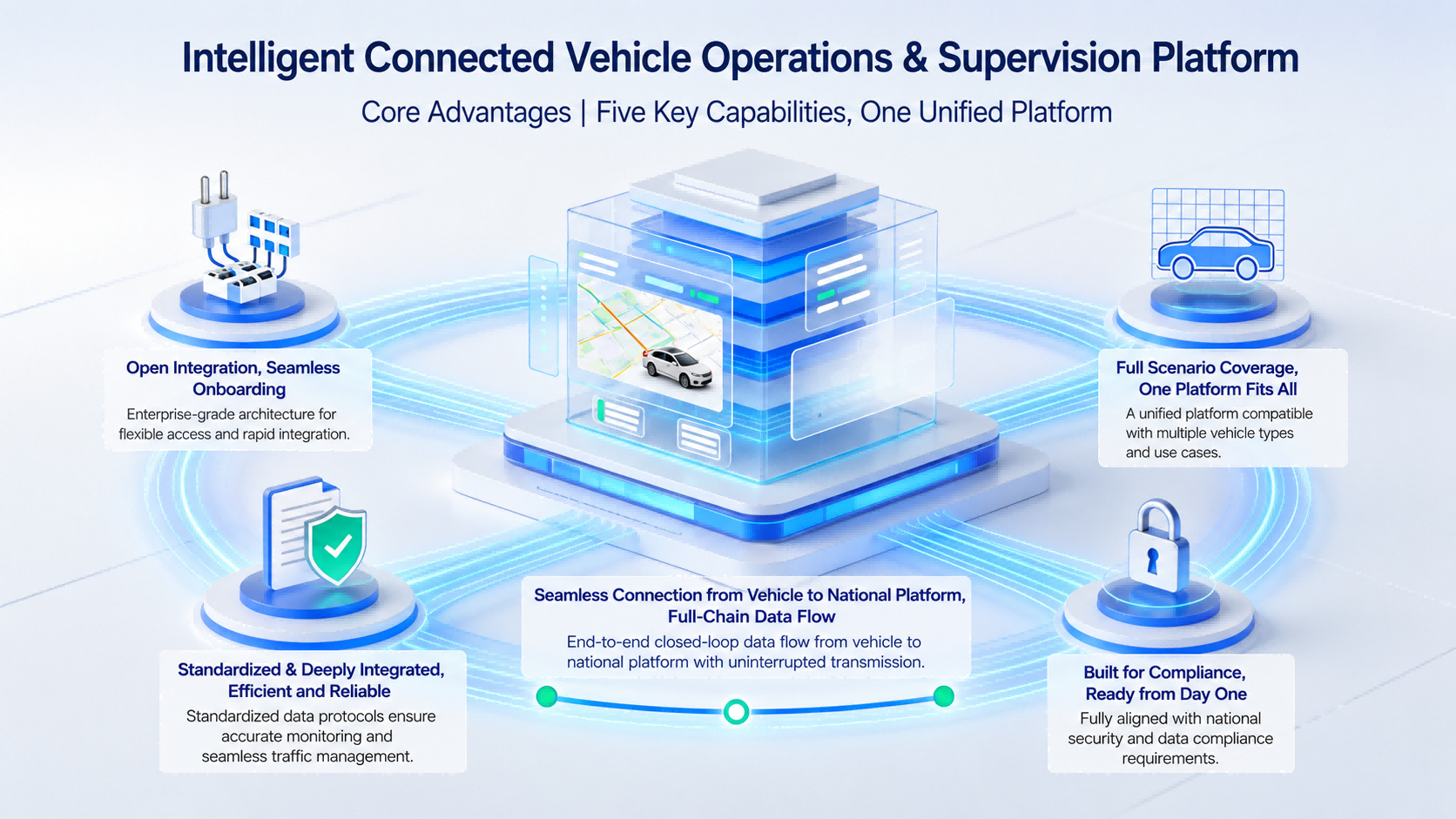
Standard Deep Collaboration, Efficient Access Certification
Sirun collaborates closely with standards technical institutions, maintaining deep alignment on standard technical details and testing requirements, and completes technical research and solution adaptation ahead of schedule. Through Sirun's supervision platform solution, automakers can significantly shorten access certification cycles, reduce trial-and-error costs, and increase first-pass approval rates.
Vehicle-to-National-Platform, Full-Link Closed-Loop Delivery
From on-vehicle T-BOX data collection and encrypted transmission, to enterprise platform parsing, storage, and compliance reporting, and finally to seamless national platform interfacing — Sirun provides full-link delivery capabilities. Automakers avoid the need to coordinate with multiple parties, meeting regulatory requirements through a single integrated solution that substantially reduces system integration complexity and compliance risks.
Full-Stack Security and Compliance, Ready to Use Out of the Box
The entire chain employs TLS 1.2+ encrypted transmission; supports ≥3 years of data storage; and automatically generates compliance reports for one-click submission. Automakers can directly leverage Sirun's mature capabilities without building their own compliance systems, meeting regulatory review requirements at lower cost and higher efficiency.
Open Integration, Seamless Incorporation into Automakers' Existing Systems
Standardized API interfaces enable deep integration with automakers' TSP platforms, data middle platforms, ERP, CRM, and other systems, breaking down data silos. Support for integration with automakers' existing security systems enables unified monitoring and coordinated handling of cybersecurity incidents — without overhauls or redundant construction.
Full-Scenario Coverage, One Platform for Multiple Vehicle Types
Comprehensive coverage spans L2-level advanced driver assistance systems and L3+ autonomous driving scenarios, supporting both M-category (passenger) and N-category (freight) vehicles. Whether for passenger or commercial vehicles, a single platform adapts uniformly — no need for separate implementations per vehicle type.
Keeping Every Intelligent Connected Vehicle Safe Under Clear Rules
Intelligent connected vehicle operation and supervision is moving from "optional" to "mandatory."
Sirun builds upon over a decade of connected vehicle expertise and experience serving 100+ clients, providing automakers with full-link compliance solutions spanning vehicle terminals to cloud platforms.
Vehicles can be driverless — supervision cannot be unmanned.
Sirun's Intelligent Connected Vehicle Operation & Supervision Platform ensures every intelligent connected vehicle operates safely under "visible" rules.

 京公网安备 11010602103187号