
In the global smart mobility landscape, Turkey is stepping into the spotlight.
This country that spans both Europe and Asia is not only important because of its geography, but also because of its ambitious investment in digitalization and smart transport, making it an emerging frontier for enterprises and investors.
A Eurasian Gateway
Turkey is one of the world’s few true “bridge nations.” To the west, it opens to Europe’s massive consumer market; to the east, it connects to the production bases of Central Asia and China; to the south, it links to the energy and trade corridors of the Middle East.

The Middle Corridor of the Belt and Road Initiative has further enhanced Turkey’s role in cross-border trade and logistics. Mega projects such as Istanbul Airport and the Marmaray Tunnel under the Bosporus underscore its status as the crossroads of Eurasia.
Whoever can build a smart mobility and transport ecosystem in Turkey will be well-positioned to win across Eurasian markets.
Turkey’s Smart Mobility Takeoff
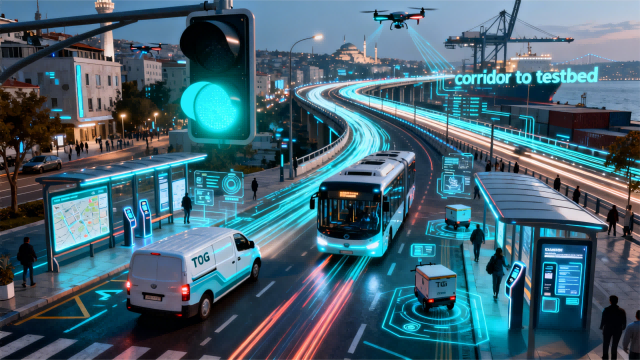
Turkey is not merely catching up—it is looking to leapfrog.
Smart traffic management: Cities like Istanbul are deploying AI-driven signal control and integrated e-ticketing systems to address world-class congestion.
Digital logistics corridors: IoT monitoring is being rolled out across highways and ports to ensure end-to-end visibility of freight.
New energy and smart vehicles: Turkey’s homegrown EV brand TOGG reflects ambitions to join the European smart vehicle market.
All of this is transforming Turkey from a “transport corridor” into a testbed for smart mobility.
Where the Opportunities Lie
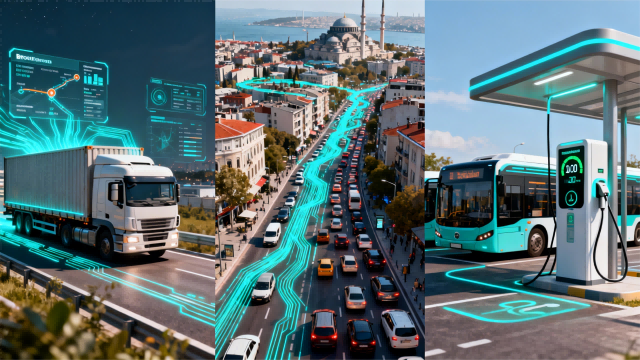
Turkey’s smart transport demand is emerging in three major areas:
Digitalized cross-border freight
Trucks and rail corridors that connect Europe, Central Asia, and the Middle East increasingly need solutions for real-time monitoring, compliance, and smart scheduling.
Urban congestion management
Istanbul, one of the most congested cities globally, urgently requires digital upgrades in public transit, ride-sharing, and last-mile delivery.
Green and sustainable mobility
With Turkey pledging a 41% emissions reduction by 2030, EV adoption, low-carbon logistics, and clean public transport are becoming policy priorities.
Challenges Along the Way
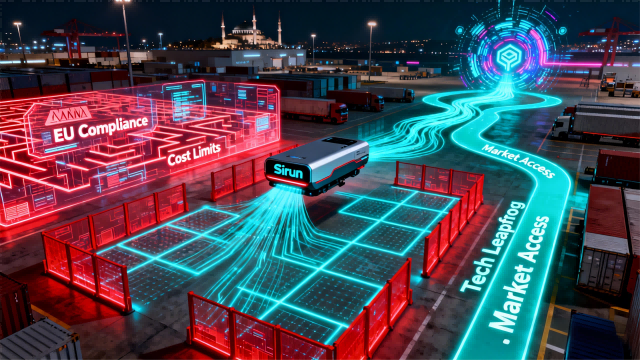
The Turkish market is not without hurdles:
Regulatory complexity: Alignment with EU transport and data standards is essential.
Urban-rural divide: Digital infrastructure is advanced in cities but still lacking in rural corridors.
Cost sensitivity: Highly competitive operators need solutions that balance efficiency with affordability.
Paradoxically, these “imperfections” also create windows of opportunity for international collaboration.
Sirun’s Perspective: A Digital Bridge for Eurasia
At Sirun, we see Turkey not only as a geographic bridge but also as a bridge of innovation.
What matters is not just moving vehicles, but connecting entire mobility systems with data and intelligence.

Using IoT and digital platforms to make cross-border freight fully transparent;
Applying smart scheduling and predictive analytics to ease urban congestion;
Supporting low-carbon transitions in fleets and public transit.
From Turkey, we see a pathway leading to the future of smart mobility across Eurasia.
Conclusion
Transport is never just about roads and vehicles—it is the bloodstream of economies and societies.
As Turkey accelerates its journey toward digital and intelligent mobility, it is also sending a signal to the world:
A new smart mobility model is taking shape here.
For Chinese and global enterprises seeking to expand overseas, Turkey may well be the next starting point that cannot be ignored.

 京公网安备 11010602103187号